Three Counters, One Question: Judging High-Strength CBD Across the UK High Street

Photo: Chris Whippet , CC BY-SA 2.0, via Wikimedia Commons
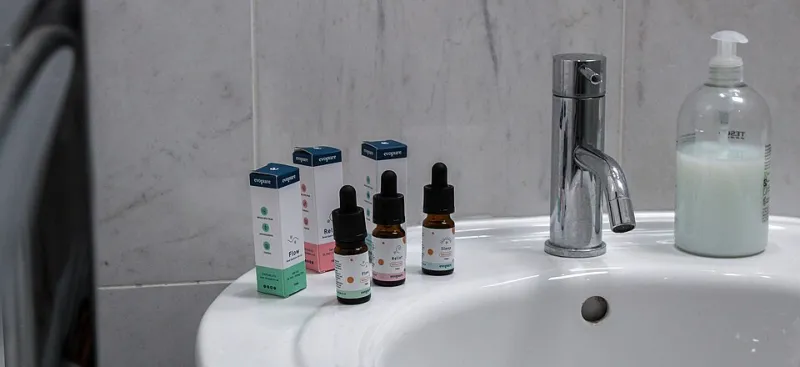
Walk the length of a British high street and you will encounter high-strength CBD sold in at least three distinct retail environments: behind a pharmacy counter, on the shelving of a vape shop, and in the supplement aisle of a health food retailer. The products overlap. The framing does not. Each channel carries its own assumptions about the customer and its own characteristic weaknesses, and an experienced buyer can extract useful signal from both.
What follows is not a ranking of shops but a reading of channels — a practical audit of what each setting tells you before you have opened the bottle.
The pharmacy counter
Pharmacies occupy the most regulated position on the street, and it shows in the range they carry. CBD oils are not licensed medicines, a point the MHRA has been consistent about, and most pharmacy chains therefore stock CBD as a food supplement rather than as a treatment. Strengths tend to be moderate; the most potent lines are often available only online or by request.
The genuine advantage here is pharmacological literacy. A pharmacist can discuss how CBD interacts with the cytochrome P450 enzyme system and what that may mean for someone taking warfarin, clobazam or certain antidepressants. That conversation is worth more than most on-pack claims, and it is not reliably available anywhere else on the high street.
The limitation is product-level depth. A pharmacist may know the pharmacology well and the individual brand poorly. Expect little detailed knowledge of certificates of analysis, carrier oils or batch testing. Ask two questions — what is the milligram content per millilitre, and where is the certificate of analysis — and the answer will tell you how much product scrutiny sits behind the recommendation.
The vape shop
Vape shops offer the widest format range in the country: e-liquids, capsules, oils, topicals, and occasionally concentrates. Staff enthusiasm is often high and product knowledge variable, which is not the same as unreliability but does mean the burden of verification shifts to the customer.
The format confusion is the real hazard. Oils are frequently labelled in milligrams per millilitre while e-liquids are labelled in milligrams per millilitre of a very different base, and the two figures are not comparable in practice. A 1,000mg bottle of oil and a 1,000mg bottle of e-liquid are not equivalents, and a shop that presents them as such is not helping.
Recurring red flags in this channel include claims of near-total purity expressed as a percentage, unbranded or unlabelled terpene additions, oral products sold with no dosing guidance, and full-spectrum assertions unsupported by any document. The absence of a certificate is common; the presence of one is a strong positive signal.
Where vape shops genuinely excel is device and formulation literacy. A conversation about PG to VG ratios, coil resistance and vapour temperature is a conversation about how much of a substance you actually inhale, and a good staff member can explain it clearly.
The health food aisle
Health food retailers occupy the conservative end of the market. Strengths are typically modest — few lines exceed 10% — and the framing is firmly that of the food supplement: clear labelling, ingredient lists, best-before dates and batch codes. Compliance with novel food requirements is generally more visible here than elsewhere.
For the high-strength buyer this channel is often a dead end on potency. Its value is comparative. Seeing how a careful retailer labels a 500mg product — per-millilitre figures, carrier oil disclosed, coding legible — gives you a template against which to judge the more aggressive products sold elsewhere. If the vape shop bottle looks worse than the supermarket-adjacent one, that is information.
Staff knowledge tends to be generalist. Questions about cannabinoid ratios or certificate retrieval may not land.
Where exaggeration clusters
Across all three channels, promotional distortion follows predictable patterns.
- Bottle-level milligram figures. A large number on the front that refers to the whole bottle rather than a serving or a millilitre. The arithmetic is rarely done for the customer.
- Purity percentages. Statements of 99% purity applied to an isolate used in a blend, and then implied to describe the finished product.
- Full spectrum without documentation. A meaningful claim about minor cannabinoids that no certificate supports.
- Clinical or therapeutic language. Assertions that sit uncomfortably with food supplement status.
- "No THC" as a differentiator. Trace THC thresholds are a compliance baseline, not a premium feature.
- Novel food ambiguity. Products whose regulatory position is unclear, sold without comment.
Hype concentrates where the customer is least likely to ask for a document — which is why the same claims appear in all three channels but are challenged in only one.
A checklist before leaving the shop
- Is the strength stated both per millilitre and per bottle?
- Is a batch code visible on the packaging, and can a certificate be retrieved from it — ideally by QR code or a code lookup on the brand's site?
- Is the testing laboratory named?
- Is the carrier oil disclosed?
- Is the best-before date plausible relative to today, and is the packaging light-protective?
- Can a member of staff answer, without leaving the counter, what the milligram content is per drop?
- Is the price per 100mg of CBD sensible relative to comparable products?
- Is the format appropriate for the dose you intend to take?
- Does the product's regulatory framing match its claims?
Two of these questions — the per-millilitre figure and the retrievable certificate — will resolve most of the uncertainty in under a minute. A shop that handles both comfortably is a shop worth returning to, regardless of which of the three channels it occupies.
Channel as signal, not verdict
No retail environment guarantees a good product, and none guarantees a bad one. Pharmacies can stock indifferent brands; vape shops can stock excellent ones; health food aisles can be conservative to the point of irrelevance for the high-strength user.
The useful habit is to treat the channel as one more piece of evidence, weighed alongside the certificate, the labelling and the willingness of the seller to answer a specific question with a specific answer. On a high street with three counters selling the same molecule, that discipline is the only reliable filter.